CHANGE & DEVELOPMENT IN
iNDUSTRY, AGRICULTURE & tRANSPORT
Some Observations by Noel Walley.
© N.R. Walley, 2001
TABLE OF CONTENTS
Industrial Development – Thomas Williams & Co.
Observations on Social Causes & Consequences
Road Transport and Communication
Rail Transport and Communication
North Wales Commuters – The Llandudno and Manchester Club Trains
Summary – Trains from Llandudno Junction (Weekdays) 1947 & 2001
By the same Author:
NORTH STAFFORDSHIRE RAILWAY PASSENGER SERVICES
INDUSTRIAL INFLUENCE ON THE LANDSCAPE IN SNOWDONIA
LLANDUDNO CATHOLIC CHURCH
Author’s Preface
This paper was
inspired by aspects of a ten-week course on "Change and Development in
North Wales” organised by Coleg Harlech
The paper
consists essentially in three essays, one on an aspect of industrial
development in
Noel Walley,
Llandudno, 2001
Industrial Development – Thomas Williams & Co.
Great men are often very complex characters and this seems to be so in Thomas Williams’ case. I found his story quite captivating and it was interesting to contrast the opinion of his workmen who called him ‘Twm Chwarae Teg’ (Tom Fair Play) and that of his business rival Matthew Boulton. It was Boulton who first called Williams the ‘copper king’ – ‘the despotick sovereign of the copper trade’. To his friend and agent he said ‘Let me advise you to be extremely cautious in your dealings with Williams.’ He spoke of Williams as ‘a perfect tyrant and not over tenacious of his word and will screw damned hard when he has got anybody in his vice.’ Of the Cornish producers, Boulton said ‘they would not have submitted to be kicked and piss’d on by me as they have been by them’ (Williams & Wilkinson – partners at one time).
Williams’ tenacity as a lawyer was very evident when acting for the Hugheses of Llysdulas who were in an acrimonious dispute with Sir Nicholas Bayly of Plas Newydd concerning the Parys Copper Mine. This dispute, which ran for over nine years, involved the interpretation of that very unsatisfactory testamentary device called a moiety. At one stage the dispute involved four years of expensive litigation in the Chancery court with the Attorney General and the Solicitor General acting for opposing sides and was not finally settled until 1778. In that year Sir Nicholas leased his own copper mine to a London Banker John Dawes (a secret associate of Williams) for 21 years.
Williams emerged from the
dispute as the managing partner with the Revd Edward Hughes and John Dawes in
the Parys Mine Company. This under Williams control was cheap to run and
extremely productive. His great problem was to obtain an attractive price
for the copper. He faced a cartel of copper smelters whose aim was to buy cheap
and sell dear. He moved decisively to establish his own smelting facilities and
quickly entered into an agreement with John Mackay to establish an industrial
complex at Ravenhead near
He also acted quickly to absorb or control other producers – notably the Cornish mines to produce a complete response to the cartel. Although always the driving force, Williams built up and controlled a major commercial organisation and surrounded himself with able staff. The Revd Edward was always a sleeping partner but younger brother Michael Hughes was an able manager. Other partners and staff included The Earl of Uxbridge, Owen Williams, and Thomas Harrison.
His business organisation was
first rate. He developed the technique of establishing his various businesses
in separate companies. Thus the Parys Mine Company controlled its own smelting
in
The
Thomas Williams of Llanidan
was clearly a complex character; some would say an unscrupulous cheat.
Certainly he was a decisive man who could and did act quickly, as on the
occasion when, without regard for his depositors, he closed the doors to pre-empt
a run on his
The Agrarian Revolution –
Observations on Social Causes & Consequences
– A Personal View
This session raised for me
more problems than it solved. That there was a clear need for reform in
the 18th century was undeniable and the story was well told. What
wasn’t clear was why this should be so and I allowed myself free rein to
consider the matter more fully. There was a significant shortage of food for
labouring people – food is always available for those with money. Thomas
Williams apparently complained that the villagers on
In a different part of
Agriculture was the great
gift to the world of the Mesopotamians and they developed considerable skill in
the efficient sowing of crops – recording some quite remarkable yields. The
Romans introduced to Britain cultivation and husbandry on a large scale and by
good organisation and management (and indeed some early mechanisation) they
were able to secure the very high yields (much higher than subsequently) that
were needed to meet the heavy demands for food and wine of the resident army,
the multitude engaged in metalliferous mining, and both the rural and the
increasingly urbanised native populations of Britain; together with a surplus
for export. In the centuries following the collapse of the Romano-British
civilisation,
Additionally, in the post
Roman era,
This use of the church for population control was fortuitous rather than planned, indeed the churches were and are traditionally opposed to birth control, but down the centuries and from an early date the monasteries were undoubtedly used as population and inheritance regulators [e.g. sons – the first to the family title, second to the church, third to the army, fourth to a trade etc., to prevent fragmentation of estates with consequent loss of power – Welsh traditions, I understand, were rather different – but some Welshmen did become monks for family reasons].
A notable case was that of
the Welsh Henry
The Anglo-Saxon kings had
also been adept at using the monasteries to accommodate and regulate surplus
princesses and royal widows. The traditional Anglo-Saxon Royal monastery
was a double monastery of monks and nuns living in entirely separate houses on
the same site but jointly ruled over by a Royal or a Noble Abbess. The monks
celebrated Mass, studied, wrote and provided the spiritual direction for the
community. For their part the lay brothers would do the heavy work of the
monastery including maintenance of the abbey buildings, labouring on the abbey
farm and managing the extensive outlying estates as well as providing
protection from attack for the monks and also for the nuns. Their duties would
include the production of elaborate needlework for the abbey and the
The suppression of the
religious life during the ecclesiastical reformation under Henry VIII, and
later, under Edward VI, the suppression of the chantry chapels and schools and
the abolition of compulsory celibacy among the clergy, led to a steadily
increasing population especially among clergy families and the ruling classes
who generally expected and therefore secured a far better than average standard
of living. The great monastic and chantry estates, ‘privatised’ by the
government of the day, would be insufficient to support the overburden of
families (children, grandchildren, great-grandchildren) in exponential growth
of those who were no longer given the opportunity of a celibate religious
vocation. The 10,000 parochial clergy of
In the event, population in England & Wales rose from under 4,000,000 at the start of Queen Elizabeth’s reign in 1558 to 5,500,000 at the start of Queen Anne’s reign in 1702 and then rocketed to 9,000,000 by 1801. It is not said that this is the result of the abolition of clerical celibacy, only that the latter was a factor.
It is now recognised in
many church circles that, notwithstanding the spiritual value of self-denial,
the real aim of ‘fasting and abstinence’ was to limit food consumption in order
to conserve food stocks and in particular to ban the eating of meat, including
eggs, in the early spring – when in fact little was available – in order to
preserve the breeding stocks. It is very noticeable that the Friday,
Lenten, and Vigil fasts were not changed in the 16th and 17th
century church reforms and continued to be rigorously enforced by government
decrees during the Elizabethan and Stuart periods. They are all specified in
the tables at the front of the 1662 Book of Common Prayer and amount to about 120 days each year on which the
eating of meat was totally forbidden by law and frugality was encouraged. This
was of course the situation not just in
By the mid 18th century, the old Lenten fasting disciplines had broken down (except in Catholic Countries) resulting in further food shortages amongst the poor. Population was growing rapidly and Agrarian reform, long overdue, was inevitable.
Road Transport and Communication
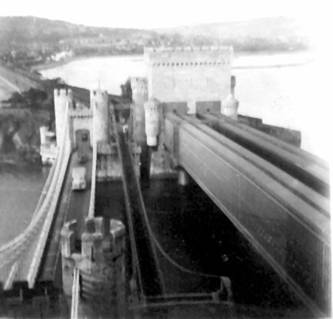 The value of Thomas Telford’s work in constructing
turnpike roads and especially the A5 to serve
The value of Thomas Telford’s work in constructing
turnpike roads and especially the A5 to serve
Look carefully!
There is a
Rail Transport and Communication
North
Wales Commuters – The Llandudno and Manchester
Good train services between
the
The service started in the
early years of the 20th century and the London & North Western
Railway and its successor the London Midland & Scottish provided special
saloon cars dedicated to the use of first class season ticket holders. The
saloons were serviced by an attendant who would ensure that a member’s
favourite armchair was kept free for that individual’s use. Members enjoyed the
benefits of newspapers and light refreshments en route to and from
The train started from
Llandudno at
These express services,
which were also available to third class passengers, did much to establish the
Today
The Beeching Era.
In 1961, Sir Harold Macmillan – ‘Mac the knife’ – announced in Parliament:
First the industry must be of a size and pattern suited to modern conditions and prospects.
In particular, the railway system must be remodelled to meet current needs,
and the modernisation plan adapted to this new shape.
Thus it was that Dr. Richard Beeching was appointed Chairman of British Railways in 1961 with very clear terms of reference, and within two years the Board published his report The Reshaping of British Railways, which was remarkable in many ways and not least for its shortness. This report was only 60 pages long but with 88 pages of appendices (tables of unidentified traffic studies etc. and long lists of lines, stations, passenger and freight services recommended for closure or for some unspecified ‘modification of services’) together with a supplementary volume of very inadequate maps on which very few stations were named or even shown. In his book Out of Steam Robert Adley MP commented thus:
For a task of such importance, not just for the Railways but for the nation, one can be excused perhaps for being surprised at the document’s brevity. In a mere 60 pages is analysed the existing state and future prospects of the passenger, freight and parcels services of the railways, and from that analysis were drawn conclusions, the implementation of which has had and still does have a fundamental effect on public transport in Britain.
In some ways the Beeching report and Dr. Beeching’s very short chairmanship (less than four years ending in May 1965) were valuable in that they forced the railways to improve efficiency and to concentrate their resources where they could most effectively generate income. Also, and this may seem surprising given all that has been said about him, it is recognised that during his period in office there was a significant improvement in morale (attributable largely to Beeching’s personality and management techniques) amongst railwaymen at all levels and especially in the upper managerial levels and that despite some resentment at the influx of experts from outside the industry (views largely expressed by Robert Adley). But note also the report to Parliament was 65 pages long. Most Parliamentary reports, before and since, spend the first 100 pages on the preamble. Parliament acted on that insult as the writer proposed, yet failed to learn from his brevity and his managerial skills. Yet the railway system did.
My original home was in
Crewe, and I can identify with the above from personal experience, having
worked for British Railways ten years, (apart from two years in the RAF), until
I moved in 1959 to Stoke-on-Trent Corporation. Morale was indeed at a very low
ebb in the late 1950’s, when Senior accounting men at Crewe still bemoaned the
LNWR’s takeover by the Midland in 1923 to form the
Dedicated railway operators have always run the railways with great professionalism and since nationalisation massive strides have been made to upgrade and improve the railway service. Much damage was done, however, following Beeching because changes of a fundamental and irreversible nature were made to the railway network and the railway infrastructure for relatively small short-term financial considerations. Many of the closures made under Beeching, especially of lines which appeared to be lightly used duplications of other routes, are now regretted, not least because valuable linear rights of way have been lost in piecemeal disposal of railway land.
However, with the dead wood dramatically cut away, the trunk lines were able to concentrate on that which they do best – fast and frequent ‘Intercity’ services (an entirely British concept of c1970 – later imitated throughout the world, and even to the extent of copying the name) between railheads and major centres of population, commerce and industry.
Everyone knows of Dr Beeching yet few would be able to name Sir Peter Parker, Chairman from 1976 to 1983, who recognised the social importance of the railway network and the obligations arising there from. He was an energetic chairman and a persuasive advocate of railways and did much to ensure continued public financing of those railway services that were deemed to be socially necessary. In retirement, he is an official Patron of the Ffestiniog Railway Company (one of six named by the company).
Welsh lines that owe their
survival to Sir Peter’s social railway policy include the
The following table illustrates some of the very great improvements made in the North Wales Coast passenger train services arising from the ‘Social Railway Policy’ promoted by Sir Peter Parker and largely resulting from his proposals, but with continuing improvements over the years. About three quarters of the trains operating these passenger services have been replaced within the last five years by fast modern air-conditioned trains in a massive ongoing investment programme.
Summary – Trains from Llandudno Junction (Weekdays) 1947 & 2001
Train times have been obtained from published winter timetables for 1947 and 2001.
1947
was the last year of operation by the
The numbers of through trains are shown together with the best journey time available.
Further study would show that the passenger service in 1947 was very similar to that of 1939 or 1924 or indeed 1910. There were very few improvements during the 1st half of the 20th century; since steam operated railways had by 1910 effectively reached the limits of economic development.

|
|
|
|
|
|

|
|
|
|
|
|
October 2001 - Through
Trains - Llandudno Junction to
Llandudno Junction
depart:
Manchester Piccadilly depart:
Almost all trains normally take less than two hours.
NOTES & REFERENCES
J. R. Harris, The Copper King: A biography of Thomas Williams of Llanidan (Liverpool University Press, 1964).
J. R. Harris, The Copper King: A biography of Thomas Williams of Llanidan (Liverpool University Press, 1964).
Several web sites were useful including http://www.angleseymining.co.uk/ParysMountain/AHT.htm which is the official Amlwch Industrial Heritage Trust site, and http://www.rhosybolbach.freeserve.co.uk/ being the site of the Parys Mountain Underground Group, which is dedicated to the archaeology of the site.
J. R. Harris, The Copper King: A biography of Thomas Williams of Llanidan (Liverpool University Press, 1964).
Some Welshmen did become monks for family reasons – a good example of this was our very own Saint Tudno about whom Margaret Williams & T. F. Wynne tell us that Tudno was one of the seven sons of king Seithenyn whose legendary kingdom in Cardigan Bay was submerged by tidal activity. Each son in reparation for his father's neglect (so it was seen – for ‘Seithenyn and his court had given themselves up to eating and drinking, and that greater wickedness – insolent pride of heart’) studied in St. Dunawd's college at Bangor Iscoed. Four sons became monks and missionary hermits.
G. M. Trevelyan, O.M., English Social History (London, Longmans, Green & Co., 1942 & 1955) Ch XI page 341.
The Book of Common Prayer according to the Use of The Church of England (London, Eyre and Spottiswoode Ltd) A Table of the Vigils, Fasts, and Days of Abstinence to be observed in the year.
G.
M. Trevelyan, O.M., English Social History (London, Longmans, Green
& Co., 1942 & 1955) Ch
Henry
Rees Davies, A Review of the Records of The
Robert Adley, Out of Steam: The Beeching years in hindsight (Wellingborough, Northants: Patrick Stephens Ltd, 1990), page 34. [Quotation from Hansard]
British Railways Board, The Reshaping of British Railways - Part 1: Report and Part 2: Maps (London: H.M.S.O., 1963).
Robert Adley, Out of Steam: The Beeching years in hindsight (Wellingborough, Northants: Patrick Stephens Ltd, 1990), page 34.
First
North Western Trains
Email: Author or Webmaster
By the same Author:
NORTH STAFFORDSHIRE RAILWAY PASSENGER SERVICES
INDUSTRIAL INFLUENCE ON THE LANDSCAPE IN SNOWDONIA
LLANDUDNO Queen of welsh resorts
Links Updated August 2005